

Beyond a challenging academic experience, children are exposed to various specialty classes that expands their learning beyond books – all from a Christ-centered perspective.
Art
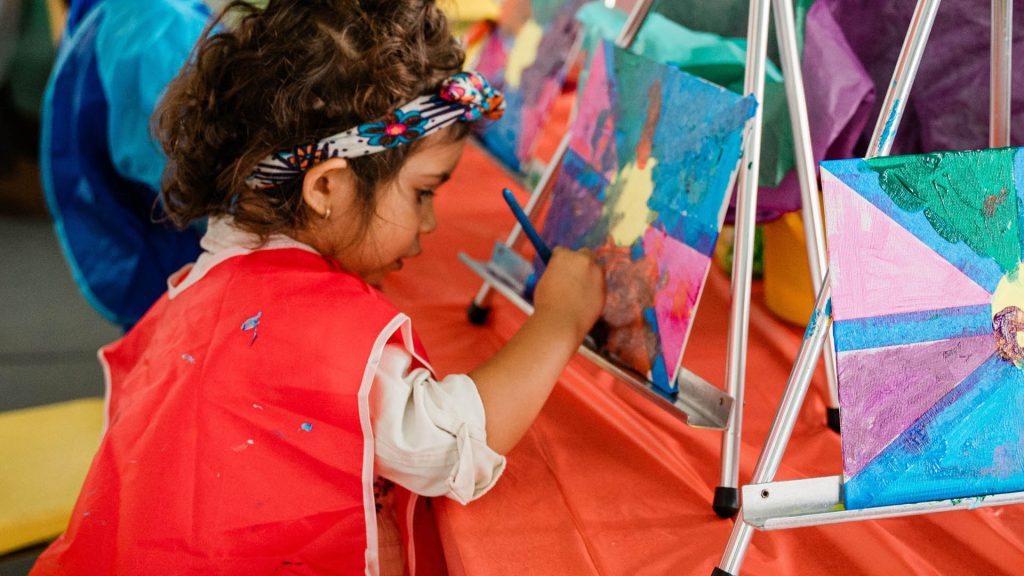
It is our desire that students see art as a gift from God to be used for His glory. A well-rounded art program provides the student with the opportunity of getting to know Him. Each individual lesson broadens the child’s total art experience, as well as each new medium introduced. The variety in media used stimulates interest at any grade level. Each student is encouraged to express feelings and emotions in a manner which will glorify God. The expressions of art, as in any other area of life, must be done to the glory of God (Col. 3:17).
Art incorporates all different types of paint, sculptures, canvases, and more. In our art studio, students will engage with our SmartBoard to take virtual museum tours where they also learn more about Art History. Some of the student’s objectives in this class are to:
- Produce original art through the use of line, color, texture, shape, shading an space.
- Learn about the color wheel, how to blend colors and make shades of colors from primary colors.
- Learn watercolor and paint techniques.
- Develop art skills through creative activities.
Media Center
Our Media Center helps students build essential technology, research, and reading skills for today’s digital world. Through computer science and literacy experiences, students learn to think critically, solve problems, communicate creatively, and engage confidently with technology and books.
Preschool students use age-appropriate computer programs to reinforce classroom concepts such as letters, colors, and numbers. They also enjoy storytelling, songs, author studies, and thematic library lessons that support early literacy and curiosity.
Elementary students develop computer vocabulary, typing, and coding skills through activities such as debugging, nested loops, relay programming, and Play Lab games. Library instruction introduces writers, genres, book series, biographies, history, science, cultures, and personal-interest topics that encourage a love of reading.
Elementary students may check out books to support Accelerated Reader goals. All students participate in book fairs, author visits, and special events throughout the year.
Music
It is our desire that the students see music as a gift from God to be used for His glory. Scripture is full of references to singing and making music, beginning in Genesis (4:21) and continuing through Revelation (15:3). Man, as created in the image of God, is naturally a musical being. The natural response to the blessings of God in the life of a Christian is that of singing praise to His name (Ex. 15:1; I Chron. 16:9; Psa. 51:14, 149:5; Luke 32:17-19). Thus, it is important that the students learn music. Music, as any other area of life, must be done to the glory of God (Col. 3:17). Proper standards must be instilled on the basis of the Word of God (I Cor. 14:15; Col. 3:16)
In this high-energy class, once a week, children learn about early music theory ( tempo, beat, etc.), composers, the use of different instruments, rehearse for their music productions that take place in the Winter and Spring and much more. Some objectives are to: instill in the child an appreciation of music as a gift of God to be used for His glory and to provide opportunities to praise God in song, acquaint the student with outstanding composers, enable the student to acquire knowledge of basic musical elements, learn about the characteristics of different musical style periods, knowledge of basic musical elements, and more.

Pelican Program
The Pelican Program is an Experiential Learning Natural Sciences Program developed by Nature Postings to enrich the science curriculum at Christ Fellowship Academy through hands-on, inquiry-based, interdisciplinary learning.
The program is Bible-based and recognizes the natural world as a reflection of God’s glory and creative work. Its guiding Scripture is:
“The heavens declare the glory of God; the skies proclaim the work of his hands. Day after day they pour forth speech; night after night they reveal knowledge. They have no speech, they use no words; no sound is heard from them. Yet their voice goes out into all the earth, their words to the ends of the world.”
— Psalm 19:1–4″
Originally rooted in marine biology and environmental studies, the Pelican Program has expanded across the natural sciences, including life, physical, earth, chemical, environmental, and physics-based studies. The program connects classroom concepts to real-world experiences through laboratory activities, field studies, investigations, excursions, and community-based learning.
Physical Education ( P.E.) / Recess
Physical Education is concerned with the physical development (basic motor development, physical fitness, and sport-skill development) of all students. Of greater importance than a child’s physical skills is the learning to excel in sportsmanship, leadership, social behavior, and care of body. These qualities reflect the character of God and enhance the child’s service for God.
Our preschool students go to recess daily on our playground where gross motor development thrives through climbing, running, jumping, hopping, skipping and taking turns.
Our elementary students learn about sportsmanship, participate in different sports, and more. Some of the student’s grade-specific objectives are to: develop sensorimotor skills, practice manipulative skills, learn balance-control movements, develop overall physical fitness – flexibility, agility, endurance and coordination, learn body parts and movement directions, and more.

Robotics
Our Robotics Program, Building, Coding, Creating, and Problem-Solving with Purpose, gives students the opportunity to explore robotics, coding, engineering, and STEM through hands-on learning. Using VEX 123 and VEX GO, students build, program, test, and redesign robots while developing skills that extend beyond the classroom.
Students use tablets and coding devices to program and control their robots, learning foundational coding concepts as their ideas come to life. Through interactive STEM labs and design challenges, they experiment, ask questions, make adjustments, and try again.
Activities are intentionally open-ended, encouraging students to approach challenges in different ways rather than simply following instructions. Students use creativity, critical thinking, teamwork, and problem-solving skills to design solutions, test ideas, and learn from both success and failure.
Robotics STEM Labs help students develop coding and computational thinking, engineering and design skills, creativity, collaboration, perseverance, adaptability, and confidence in solving real-world challenges. Each challenge reminds students that there is often more than one way to solve a problem.

Spanish
The ability to communicate through language is a gift from God, reflecting the orderliness of His nature. Students are taught Spanish, giving them a unique opportunity to develop skills they can use to communicate God’s laws to others. Our Spanish program is designed to teach and reinforce pronunciation, word formation, vocabulary, and grammar. Students gain the skills needed to speak, understand, read, and write basic Spanish and apply what they have learned in everyday situations.
Preschool Spanish lessons incorporate letters, colors, numbers, shapes, and more in a fun and engaging way through puppets, Spanish books, projects, and other activities.
Elementary Spanish follows a grade-specific curriculum that engages children with age appropriate material and interactive activities that incorporate gamification.

STEAM
STEAM class allows our K2-K5 students the opportunity to experience the subject of science and apply knowledge learned in the classroom. Students use their senses to enjoy and appreciate God’s magnificent creation—nature, animals, the human body, forces of nature, bodies of water, insects, sea creatures, and space. Through experimentation and hands-on activities, students gain knowledge and develop a deeper appreciation for science and God’s world.
Learning scientific concepts at their level, students participate in activities such as classifying rocks and minerals, making fossils out of playdough, mixing safe chemicals, planting seeds, and much more. Student objectives include observing the properties of light, understanding weather, learning facts associated with plants and animals, developing basic comprehension of physics terms, and more.

Learners today, leaders tomorrow.
A world of learners where students gain a passport to the world.